Please Note: The 2025 Civic Info Challenge Application is now closed. MEET THE SELECTED COLLEGE TEAMS AND LEARN ABOUT THEIR IDEAS HERE!
- Open To:
- faculty and staff affiliated with community colleges in the US South
- What to Submit:
- bold pitches that answer the question, “How might my campus equip more people to get, share, and discuss reliable information about what’s happening in the places where they live?”
- To Know:
- 5-8 winning applicants will receive recognition from Journalism + Design; an all-expenses-paid trip to a two-day, in-person major summit in the South in fall 2025; and a chance to participate in a J+D-supported community journalism program design process
- To Apply:
- fill out the application form and submit it to J+D no later than Friday, May 16, 2025 at 11:59 am ET
- To Connect:
- join our weekly office hours on Fridays at 1:00 pm ET to brainstorm pitches and chat with J+D team members in an informal setting
The Inspiration
The Community College Civic Info Challenge invites community colleges across the South to join a national movement that equips more people to play a role in keeping their communities informed, connected, and vibrant.
Even if you’re not familiar with the phrase “civic info,” you’re probably familiar with what it is: “verified news and information that serves people by equipping them to make crucial decisions about their lives, that strengthens social bonds among people who interact regularly and share space and resources, and that creates a strong sense of connection and engagement among people who live in the same area.” Civic information is produced and circulated by many types of sources: local listservs, newsletters and social media feeds curated and edited by community members who know and care about what’s happening, local newsrooms and media organizations, even neighborhood Whatsapp or Facebook groups.
Access to civic information matters because it equips and inspires people to get more involved in their communities, and tackle complex problems–like economic mobility, the cost of health care, educational opportunity, access to clean air and water, and more–in the places where they live. And evidence shows that when more people in a community come together to solve complex problems, everyone benefits: individuals, families, towns and cities, and entire regions enjoy greater prosperity and health.
Community colleges are vital to sustaining civic information in regions like the South, where long histories of racial and economic injustice equal fewer opportunities and less formal infrastructure for people to make their needs heard. Community colleges have always been places that share, embed and nurture knowledge and skills that are important to the people in their surrounding areas. They bring people together to innovate and test ideas; to find access to basic necessities; and to converse about difficult community issues. They are trusted: in fact, over half of Americans say they have a great deal or a lot of confidence in community colleges. Most importantly, they serve many people whose perspectives have often been overlooked, underresourced, and exploited by traditional media systems.
Journalism + Design works alongside community colleges to build tools, pathways, and opportunities that enable more people to produce and distribute reliable news and information. From rural New Jerseyans who connect senior citizens with local resources via Facebook pages to community journalists in Cleveland who identify community needs and priorities around local elections through interviews with their neighbors, the people who participate in our community college-based programs commit valuable acts of journalism every day.
The Opportunity
For those reasons and more, we believe that community colleges in the South have so much to teach all of us about how we can build and nurture more participatory networks for civic information and local news. So we want to learn from community college teams who can pitch us their boldest answers to the question: “How might my campus equip more people to get, share, and discuss reliable information about what’s happening in the places where they live?”
Your pitch could be a new idea, or it could be an existing idea or program at your community college that you’d like to workshop or test with kindred minds. The Challenge’s ultimate goal is to spark conversations between folks at colleges across the South, build a field for learning, and help people obtain support and resources for implementing their ideas.
Your pitch will be read by a dedicated team of people who are knowledgeable and passionate about building connections between community colleges, local grassroots organizations, and the networks of people who create, share, and make sense of reliable information in their communities. These readers will work together to identify a cohort of 5 to 8 applicants whose pitches collectively represent a range of ideas, regions, potential communities served, and experience with/curiosity about civic information.
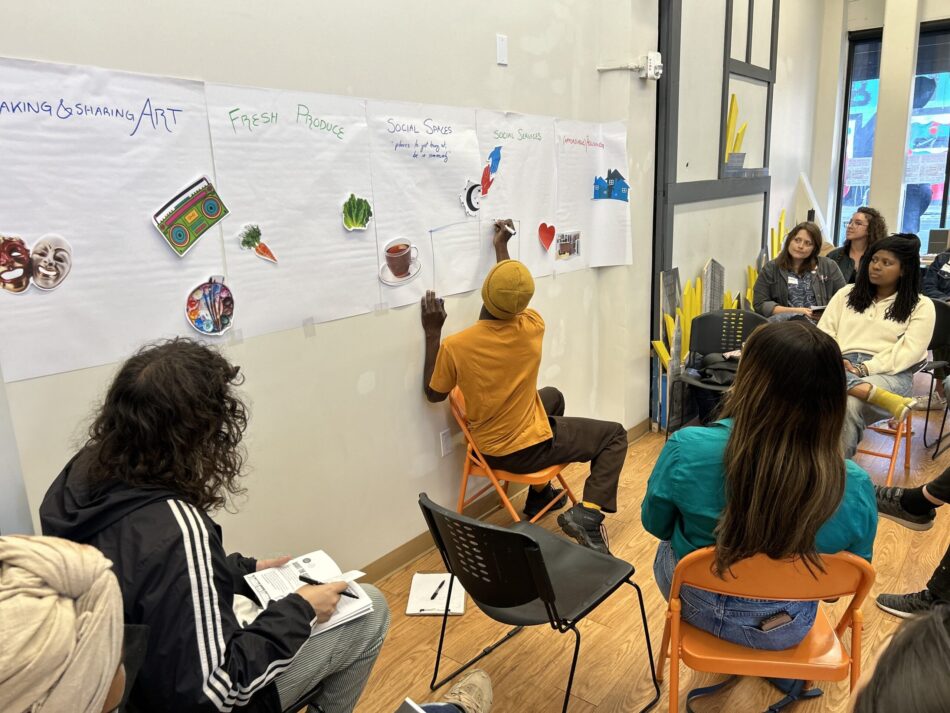
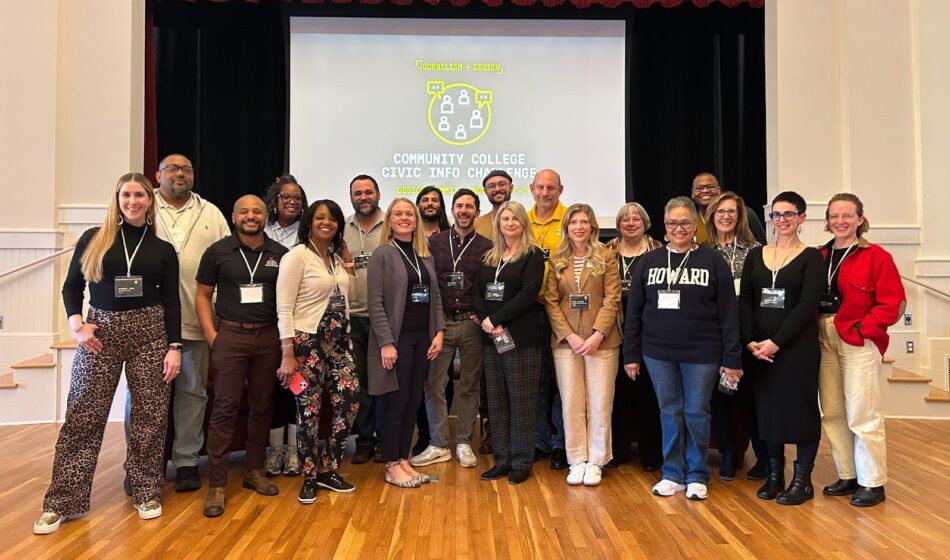
Each selected applicant will receive an all-expenses-paid trip to a two-day, in-person summit in the South in fall 2025. The summit will give people a chance to make connections; hear from others who have launched successful civic info projects and programs at their colleges; workshop their ideas with a supportive, interdisciplinary community of faculty, students, journalists, designers, systems thinkers, organizers, and artists; and find nourishment and joy in imagining how civic news can bring people together. Post-summit, the cohort also will have the option to participate in a 12-to-18-month community journalism design process, facilitated by J+D, where they will receive expert guidance to turn their ideas into implementable solutions.
Everyone who pitches an idea is welcome to be a part of Journalism + Design’s community of practice. You can join our virtual events on topics related to civic info; engage with others who want to share knowledge and build networks that equip more people to get and share reliable information about their communities; and tap into expertise, tools, and resources (such as curricula, case studies, program models, and more) that help colleges plan, create, and sustain civic info projects on their own.
Eligibility
The Challenge is open to full-time, part-time, and adjunct faculty and staff from community colleges located in the following states: Alabama, Arkansas, Delaware, the District of Columbia, Florida, Georgia, Kentucky, Louisiana, Maryland, Mississippi, North Carolina, Oklahoma, South Carolina, Tennessee, Texas, Virginia, and West Virginia.
You may apply as an individual or as a team: it’s up to you. If you do apply as part of a team, the lead applicant must be a community college faculty or staff member. We want to see pitches from people who represent many types of roles in the college and from surrounding communities. To help you imagine the possibilities: community college-based civic info projects can involve collaborations between community college faculty and staff from fields such as community engagement, experiential learning, media and communications, journalism, history, health sciences, tech, workforce development, community development and access; student-led clubs and organizations such as college newspapers or podcasts, mutual aid groups, cultural alliances, student councils/government, etc.; people who run, edit, or report for local news outlets or people who keep their communities informed through newsletters and social media channels or groups; local entrepreneurs and employers; people who work in organizations that support community information-sharing and news; and arts administrators, librarians, nonprofit staff members, organizers, and more.
We especially welcome pitches from faculty and staff affiliated with rural community colleges; historically and predominantly Black community colleges; and Hispanic-serving community colleges.
What We’re Looking For
The Community College Civic Info Challenge application process will center the following criteria:
- Collaboration: you have a track record of building thoughtful and interdisciplinary collaborations with people from across and beyond your college;
- Interest in/experience with civic information: you are passionate about how people find and share information about the issues that matter most to them;
- Ingenuity: you think broadly and creatively when solving problems;
- Capacity for self-reflection: you can analyze why a project worked (or didn’t) and are willing to unlearn mindsets and processes that can keep you stuck.
The criteria above are guides, not requirements; even if you aren’t sure if your experience meets all of the above, apply anyway!
HOW TO APPLY
Apply for the Civic Info Challenge by clicking on the button below:
Applications must be submitted no later than Friday, May 16, 2025 at 11:59 am ET.
The form provides space for your pitch and asks you/your teammates to reflect upon and respond to a brief set of short-answer questions. The questions are meant to help Journalism + Design and the people who will be reading your application learn more about the unique motivations, superpowers, skills, and values that you/your teammates will bring to the work.
We recommend that you copy the application questions into your own GoogleDoc or Word document to draft and edit your answers, as the Airtable application form does not permit you to save-and-return to your application.
Application Support
J+D is committed to supporting community college applicants throughout the application and review process. Here are the best ways to get in touch with us:
Drop in on our virtual weekly office hours on Fridays at 1:00 pm ET (beginning March 28) to meet members of the J+D team and discuss program-related questions or concerns in a collaborative setting. The more, the merrier!
We will host a virtual Community College Civic Info Challenge virtual information session in April (date TBD). The session will provide an overview of the program and application process and create space for prospective applicants to ask questions. Note: a recording of the information session will be available after the event.
Email us at poppv@newschool.edu to share specific program-related questions or concerns or to brainstorm ideas for your pitch.
FAQ
- Where can I learn more about civic information and why it’s important?
Civic information gives people access to the information that they need to make key decisions in their lives and engage meaningfully with the communities in which they live. There are a number of statewide and regional projects that explore why civic information is important and how it correlates with civic health: the Civic Information Index, the Center for Tech and Civic Life, and the New Jersey Civic Information Consortium are just a few examples.
- Who is eligible to apply?
The Challenge is open to full-time, part-time, and adjunct faculty and staff from community colleges located in the following states: Alabama, Arkansas, Delaware, the District of Columbia, Florida, Georgia, Kentucky, Louisiana, Maryland, Mississippi, North Carolina, Oklahoma, South Carolina, Tennessee, Texas, Virginia, and West Virginia.
- How did Journalism + Design decide which states would be included in the Challenge?
We consulted the US Census definition of the South in deciding which states to include.
- I’m a faculty or staff member at a four-year college or university who collaborates with community college faculty or staff in my area–may I apply for the Challenge?
No, faculty and staff from four-year colleges or universities are ineligible to apply for the Challenge themselves. If, however, an eligible community college applicant wishes to include a faculty or staff member from a local college or university as part of their team, that is acceptable.
- I’m a student at a community college in the South and I’m interested in how people in my area create and share news and information–may I apply for the Challenge?
The Challenge is open to applications from faculty or staff at community colleges in the South. Although students cannot apply themselves, we very much encourage applications from faculty- and staff-led college teams that center student perspectives and leadership and include students as co-leads or teammates.
- I need inspiration! Do you have any examples of community college-based civic information projects?
Check out Journalism + Design’s 2024 year-end review of how we co-designed local news and information programs and happenings alongside community colleges and local media and community organizations from CA to PA. It rounds up examples, anecdotes, and different program models from our community college partners, and describes how program participants used their skills to create their own community media efforts, produce original reporting, freelance for local news outlets, advocate for positive change in their cities, and more. The Center for Community News from the University of Vermont also highlights higher education institutions and faculty from around the country who are building innovative news-academic partnerships; many of their examples are from four-year institutions, but they might inspire you nonetheless.
- I need help with the application form. How can I reach out?
The Community College Civic Info Challenge application is hosted on Airtable. If you experience any challenges with filling out and submitting the form, please contact J+D’s Valerie Popp at poppv@newschool.edu.
- Do I need to create an account on Airtable to submit the application form?
No, you do not need to create an account on Airtable to submit your application form.
- What if I still have questions about the Challenge?
Share your questions by emailing poppv@newschool.edu. The Journalism + Design team is happy to help you talk through your ideas and provide advice on your pitch and application.
Thanks
The Community College Civic Info Challenge is made possible by the generous support of Lumina Foundation as part of Press Forward, a national movement to strengthen communities through better local news and information.
Lumina Foundation is an independent, private foundation in Indianapolis committed to making opportunities for learning beyond high school available to all. We envision higher learning that is easy to navigate, delivers fair results, and meets the nation’s talent needs through a broad range of credentials. We work toward a system that prepares people for informed citizenship and success in a global economy.