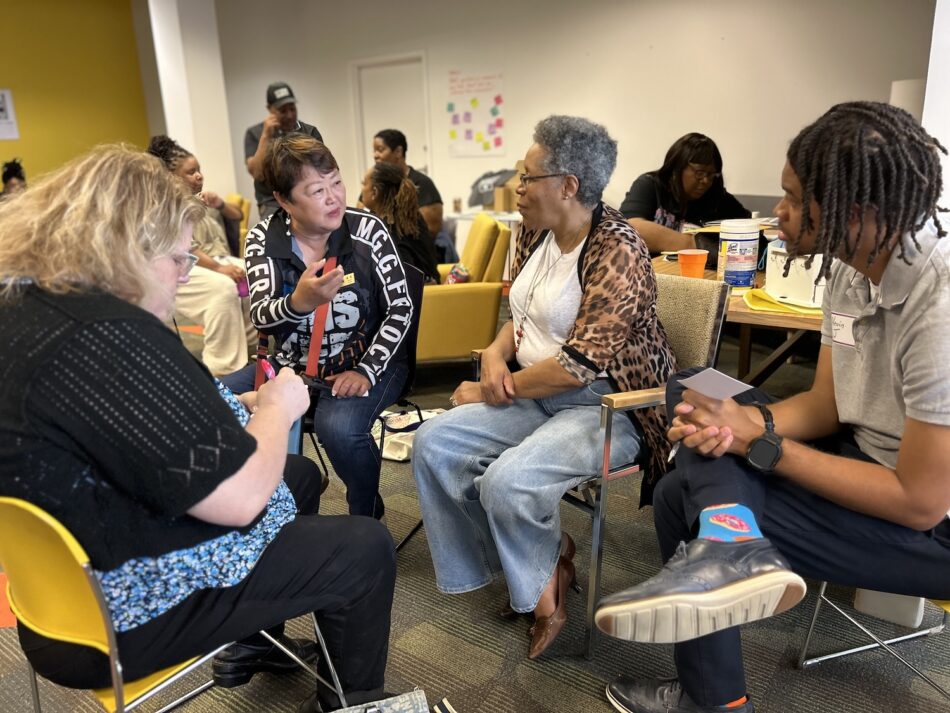
When I look back at the Journalism + Design lab’s work this year, I’m amazed at the creative ways we’ve seen people across the country stepping up to help keep their communities informed.
Take Ariana Martinez-Lott, a participant in a new community journalism fellowship we launched this year with Fresno City College and Fresnoland: She took the skills she learned during the 12-week training to explain the details of a proposed street vending ordinance to local vendors and connected them in a constructive conversation with City Council members on how it would impact them.
Or Tina Williams, a retiree in New Jersey who took a community journalism course we funded and supported at Sussex County Community College. She went on to start a Facebook page to share information with other seniors in the county and help them not feel isolated.
Louis Lyons, another community journalism fellow from a program we co-led in Cleveland, is helping organize his neighbors to fill the local news gap that will be left by their soon-to-close community newspaper, the Collinwood Observer.
What strikes me about these stories is how they show the range of ways that people can contribute to their local news ecosystem. At the J+D lab, we believe that everyone has a role to play in ensuring that reliable information is flowing throughout our communities. This is why we see our collaborations with community colleges, local newsrooms and other community-based organizations as seeds of future news systems that are more participatory and resilient.
Those of us working at the intersection of local news and civic engagement know we have plenty of challenges before us: lonelier, more divided communities; an administration outwardly hostile to the free press; a torrent of misinformation and media glut; and threats to spaces that encourage reflection and deliberation, like colleges, libraries, and other civic institutions.
However, I find hope through the networks we’ve been part of weaving in communities across the country. They show firsthand how a collaborative approach can grow more relevant, accessible and actionable ecosystems for local news.
In the new year, we’ll write more about our plans to further realize this work in 2025 and the exciting programs we have on tap. But in the meantime, we wanted to reflect on what we’ve accomplished in 2024. It’s been a great privilege and joy to be allied with so many different people who are fueling more informed, connected communities. We’re eager to build on this work next year and beyond.
2024 by the numbers
8
community college partnerships in five states
6
noncredit community journalism certificates launched
2
new paid community journalism fellowship programs
100+
people trained in community journalism
24+
Stories published in local media by community journalists
$200,000+
Distributed to colleges, newsrooms, fellows and educators
3
interactive art exhibits sourced through local journalism
Co-designing community journalism programs
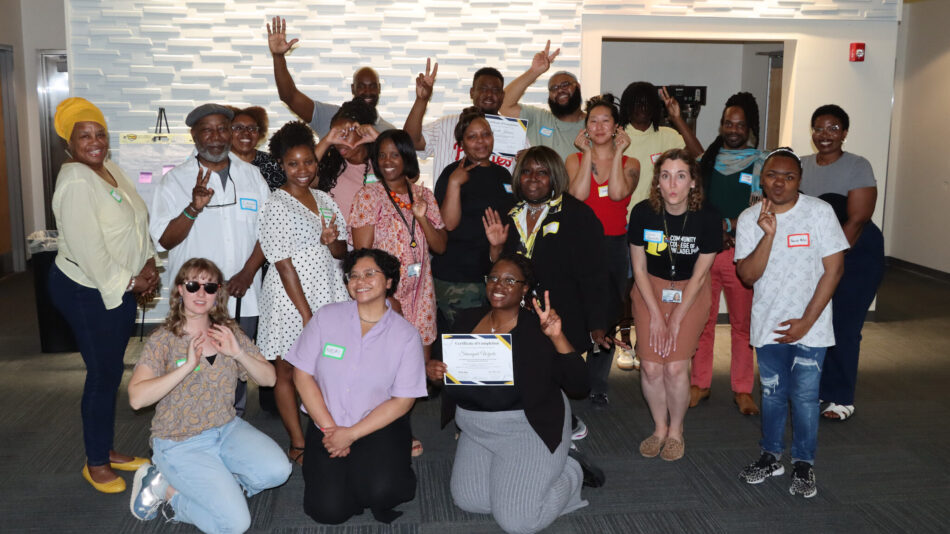
J+D teamed up with community colleges across the U.S. in 2024 to co-design and facilitate six distinctive, free programs that introduce participants to the basics of journalism and build the location-specific skills and pathways they need to put their knowledge into practice.
In New Jersey, four community colleges across the state launched their own noncredit certificate programs in community journalism with funding and support from the J+D lab and our partners at the New Jersey Council for the Humanities: Atlantic Cape Community College, Mercer County Community College, Middlesex College and Sussex County Community College.
At least 60 people participated across the four NJ programs and went on to produce original reporting, freelance for local media outlets like MercerMe, or create their own community media. We saw firsthand how a cohort can incubate new and novel program models: Mercer integrated community journalists from its “J Lab” into the college’s student newspaper, Middlesex forged partnerships with libraries and created a hub for civic information, and Atlantic Cape is launching its own Documenters program. You can read a snapshot of our impact in NJ to date in this summary from Impact Architects.
In Cleveland, our partnership with Cuyahoga Community College (Tri-C), Neighborhood Media Foundation and Signal Cleveland continued to grow. Nearly 20 people earned a certificate as part of our second community journalism course, and we hosted two mixers at Signal Cleveland to connect community and civic media practitioners and facilitate conversations about how we can work together to support more informed communities across the county.
In Philadelphia, we co-hosted the third edition of “Community Journalism for Civic Power,” a free noncredit workshop series in partnership with Community College of Philadelphia and Resolve Philly. Over 30 people regularly participated in the course; 23 received certificates recognizing their new journalism skills plus one-year memberships to PhillyCAM, a community media center that teaches people to become creators of independent media.
Hands-on opportunities for community members to meet local news needs
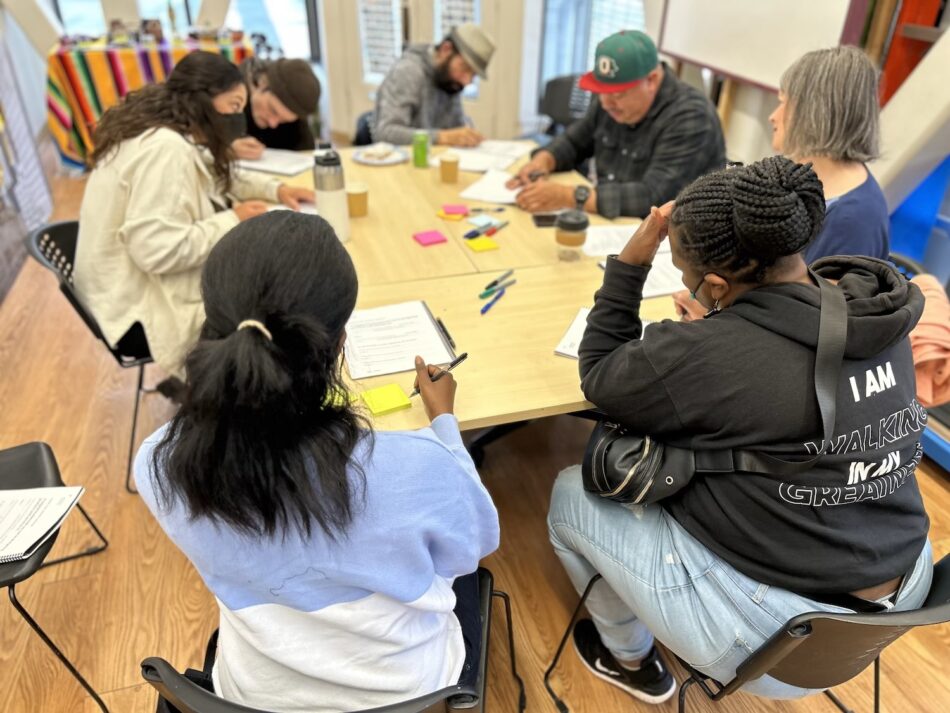
In addition to our noncredit certificate programs, we’ve co-developed a variety of new programs with our local partners that equip community members to directly identify and address local information needs and amplify perspectives that often go unheard.
Cleveland Community Journalism Fellowship. We created a new fellowship with Tri-C, Neighborhood Media Foundation and Signal Cleveland that trained and paid four participants from our Tri-C community journalism program to talk with more than 125 people across Cleveland about the election. The fellows shared critical info with community members about how to vote and key issues on the ballot, produced articles for community newspapers, and laid the groundwork for more community-informed coverage of Cleveland’s next election in 2025. You can read more about the fellows and what they learned in this piece from Frank Lewis of Signal.
Design for Community News. In Oakland, we created and led a new workshop on community news design that gave six community members the tools and inspiration to imagine new community news products. In 2025, we’ll build on this work by inviting people working in community-based organizations to develop new ways to distribute important information and spark dialogue.
Fresno Community Journalism Fellowship. In Fresno, we partnered with Fresno City College and Fresnoland to host a 12-week fellowship for community members in the city to raise important issues affecting their neighborhoods. Eight people completed the fellowship, and are already using skills and ideas from the program in a variety of ways: from facilitating conversation between street vendors and policymakers to fueling coverage in Fresno City’s student newspaper, The Rampage.
Surveying Cumberland County’s news ecosystem. In Fayetteville, NC, we advised a team of faculty and students at Fayetteville Technical Community College to survey people across Cumberland County about how they get local information and what they wanted to see from local news.
HumanitiesDC Community Journalism. In the District of Columbia, we consulted with HumanitiesDC and helped support their second community journalism training program. Check out the zine they produced from the participants’ writing and reporting.
Leveraging third spaces for local news
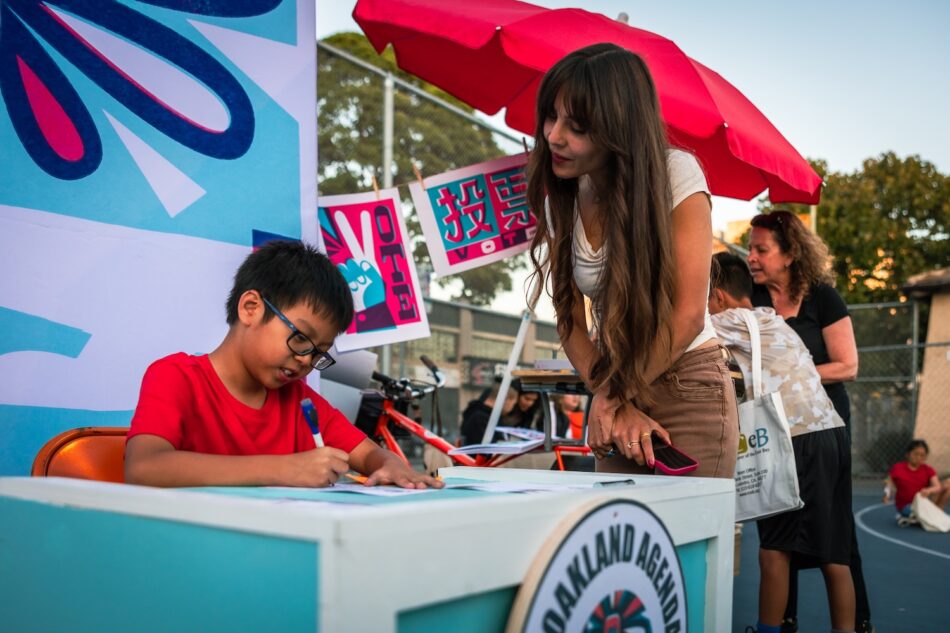
We believe in the power of creating in-person opportunities for people to connect, share and discuss news about what’s happening in their communities. That’s why we started the Oakland Lowdown, a storefront studio in downtown Oakland where we’re hosting events and workshops and partnering with local artists to tell stories and provide vital information in creative ways.
A few of our projects at the Lowdown this year include:
- “Postcards from La Pulga,” a photo and story-sharing exhibit we hosted with El Tímpano and Catchlight Local to share the vibrant history of Oakland’s La Pulga swap meet;
- “My Oakland Agenda,” a collaboration with Oakland North, a publication of UC Berkeley’s Graduate School of Journalism, that elevated Oaklanders’ priorities for elected officials through pop-up community engagements and live screenprinting;
- A collaboration with LETS Studio to host conversations about what it takes to help small businesses thrive in Oakland.
Gratitude
None of this work would be possible without the vast network of creative, brilliant and committed people we get to work with across the country every day. Our team at the J+D lab believes local news and information must be produced by, with and for communities. The partnership and co-creative energies of the community colleges, newsrooms, local news support organizations, advisory boards, and civic organizations in our network hold us to that North Star.
Here’s an incomplete list of people we’d like to thank for their partnership and co-conspiring:
- In Cleveland: Rich Weiss (Neighborhood Media Foundation), Helen Maynard and Frank Lewis (Signal Cleveland), Erika Bell, Suzanne Ortiz and John Kerezy (Cuyahoga Community College); and Charlotte Morgan
- In New Jersey: Carin Berkowitz (New Jersey Council for the Humanities); Holly-Katharine Johnson (Mercer County Community College); Sherwood Taylor and Jennifer Field (Atlantic Cape Community College); Cristóbal Espinoza-Wulach and Melissa Edwards (Middlesex College); Nancy Gallo and Cheryl Conway (Sussex County Community College)
- In Oakland: Chris Treggiari (City Studio and California College of the Arts); Hillary Carey; Humphrey Obuobi (LETS Studio); Lisa Armstrong and the students who produce Oakland North (UC Berkeley Graduate School of Journalism); Jacob Simas (The Oaklandside); Jada Folse (Lifelong Medical)
- In Philadelphia: Michelle Lopez and Olivia Edwards (Community College of Philadelphia), Lily Medosch and Rasheed Ajamu (Resolve Philly)
- In Fresno: Kathleen Schock and Paul Swearengin (Fresno City College); Dani Bergstrom (Fresnoland); Brian Kenney (CMAC)
- In North Carolina: Lizzy Hazeltine (NC Local News Lab Fund) and Joshua James (Fayetteville Technical Community College)
- In D.C.: Lois Nembhard and Dana Brozost-Kelleher (HumanitiesDC); Olive Vassell (University of the District of Columbia)
- In New Mexico: Rashad Mahmood and Mark Glaser (New Mexico Local News Fund)
- Jesse Hardman and Grace Northern (Listening Post Collective)
- Eric Garcia McKinley and Lindsay Green-Barber (Impact Architects)
- Francesca Campanella and Agnieszka Gasparska (Kiss Me I’m Polish)
This work is all made possible by the support of our funders: The MacArthur Foundation, Knight Foundation, the William and Flora Hewlett Foundation, Lumina Foundation, and the New Jersey Civic Information Consortium.
Valerie Popp contributed to this report.