
Last September, five community college students in the San Francisco Bay Area were given a challenge: develop an original piece of art about a local issue or story affecting people in Oakland and turn it into a screenprinted poster.
The project was the centerpiece of News/Print, a new fellowship program that our team at the Journalism + Design Lab launched through the Oakland Lowdown, a community hub for local news and art that J+D Lab powers in downtown Oakland.
We developed News/Print in collaboration with City Studio, a youth arts education program, as an opportunity specifically for community college students who are pursuing a range of disciplines to learn and apply journalism skills in a creative and engaging way.
Over ten weeks, our inaugural cohort of News/Print fellows – Avery Huetter, Melanie Torrez-Canales, Jay Ancheta, Danbi Han, and Krystal Situ – learned how to blend journalistic inquiry with printmaking, producing original artworks that elevate stories affecting Oaklanders. Most fellows came to the program without any prior experience in journalism. They were each studying and practicing art in some form, and were all interested in getting more involved in social issues.
Each fellow received a $1,000 stipend, participated in weekly workshops at the Lowdown’s studio, and worked closely with program facilitators Chris Treggiari and Amy Berk of City Studio to shape their research and artistic designs.
The workshops started with a grounding in journalism: how to research local issues, find credible information, conduct interviews, ask good questions, and consult multiple sources. Later sessions leaned more heavily on artistic practice, like how to translate complex ideas into compelling visuals and how to optimize a piece of art for screenprinting.
By the end of the fellowship last fall, each fellow had created their own poster, which we printed in-house at the Lowdown and displayed from our street-facing windows on a high-traffic street in downtown Oakland.
As we prepare to host our second News/Print fellowship cohort this fall, we’re taking a look back at the creative and compelling work our inaugural cohort produced.
From reporting to community-engaged art exhibit
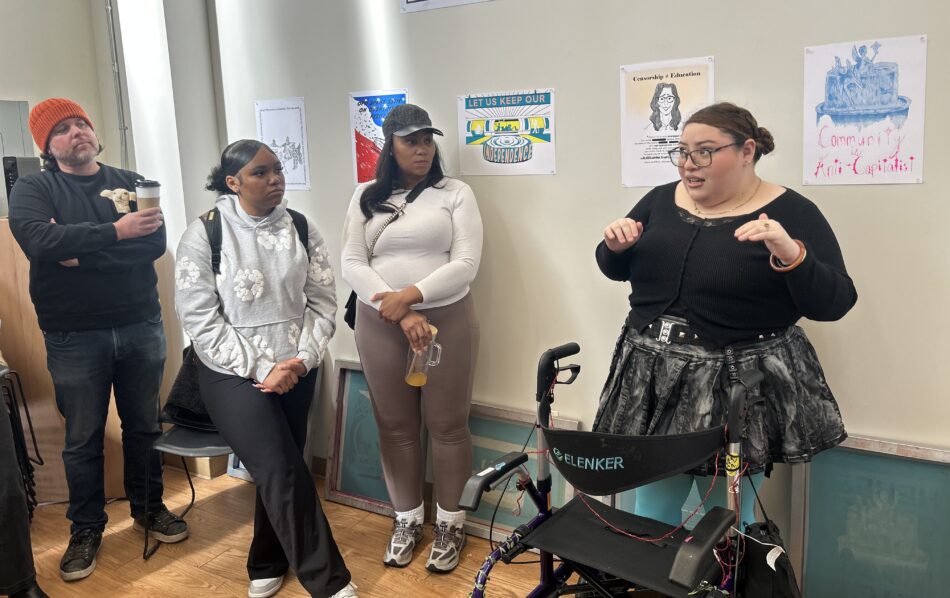
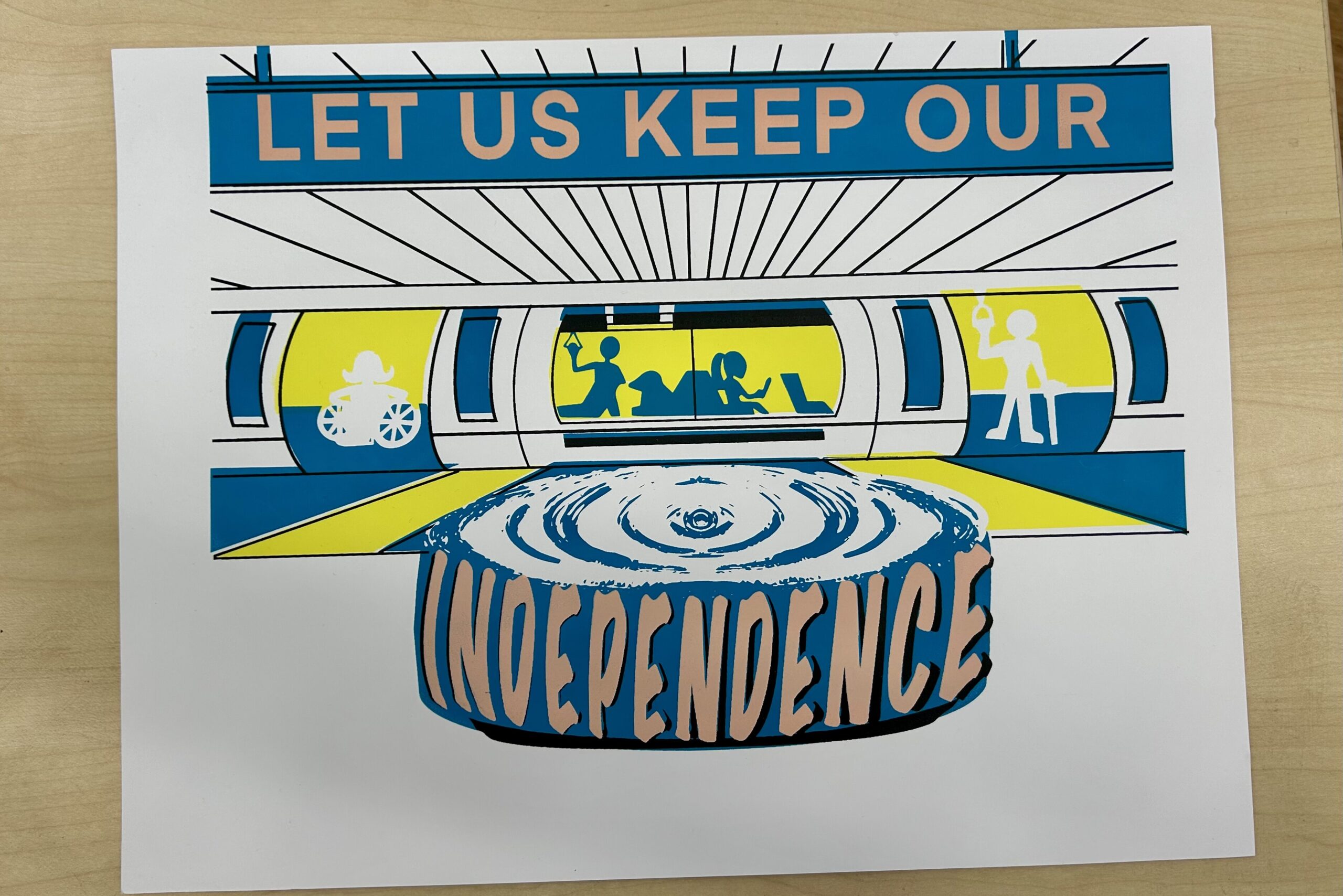
For her project, fellow Melanie Torrez-Canales chose a question that has a direct impact on her life: how is the financial crisis facing Bay Area public transit agencies affecting transportation access for people with disabilities?
As a physically disabled person, Torrez-Canales has thought a lot about the social model of disability, which essentially proposes that people are only disabled due to societal barriers and a lack of accessibility. Having read about looming budget cuts facing public transit in the Bay Area, and a related ballot measure that will be put forward to voters this November, she wanted to draw attention to their potential effects while spotlighting the experiences of people with disabilities who navigate by public transit.
After weeks of research, interviews, and firsthand fieldwork on BART, she created an original artwork that centers the phrase “Let us keep our independence.” It’s a quote that came from an interview she conducted with a peer who relies on paratransit, noting the major implications that potential service cuts would have to the lives of people with disabilities.
That process for Torrez-Canales, who is now enrolled at Emily Carr University of Art + Design, was at the heart of the News/Print fellowship: identifying a local issue that felt important and personal, investigating it through reporting, and then translating that reporting into a compelling visual that drew from lived experience.
The other four News/Print fellows explored a variety of local topics, including:
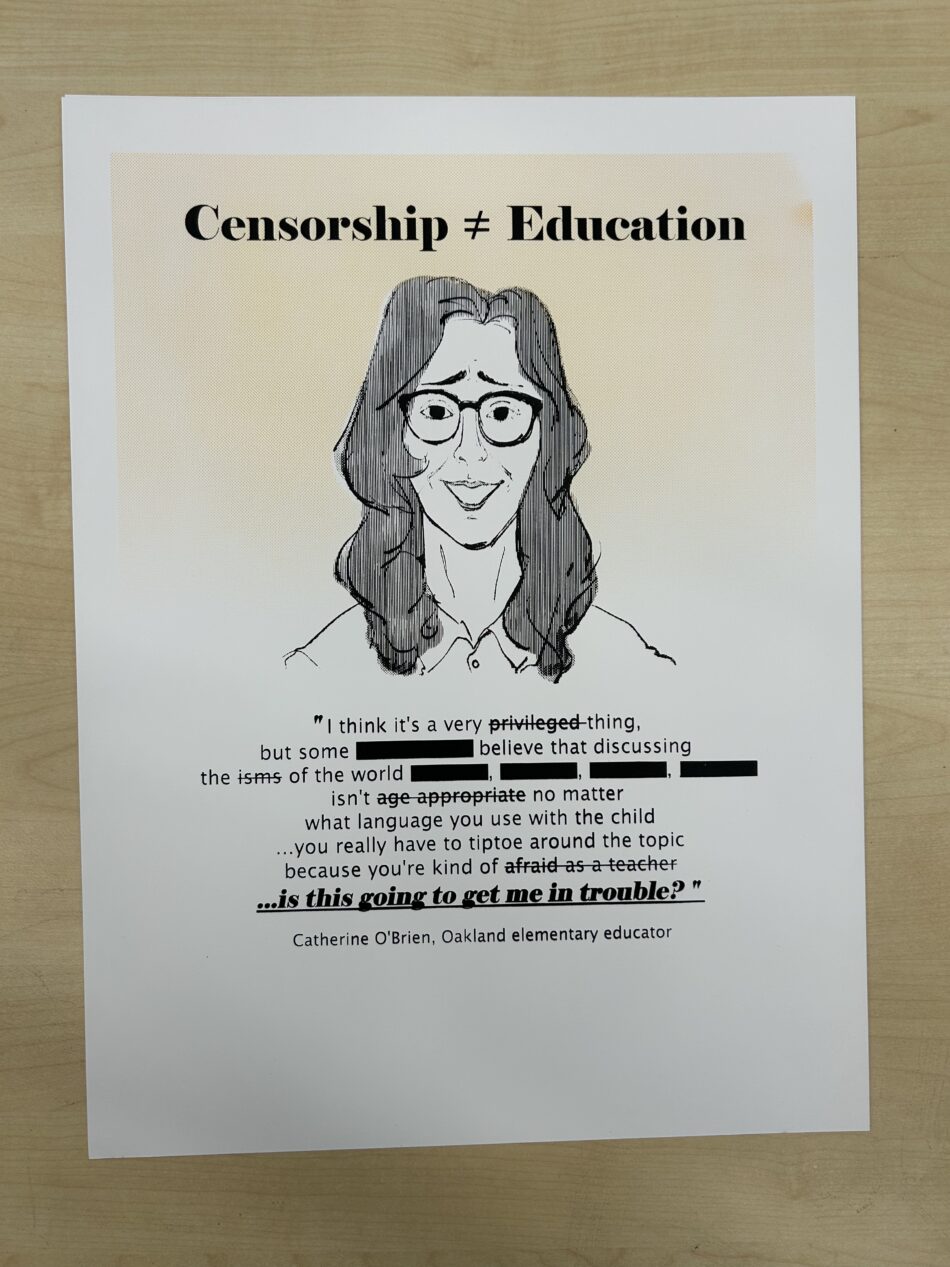
- Jay Ancheta examined how the current political climate fuels censorship in schools, particularly for teachers who feel like they can’t talk freely about issues like structural racism and historical injustice. Drawing from an interview with Oakland educator Catherine O’Brien, Ancheta’s poster uses visual redaction to confront viewers with what’s being censored, and why.
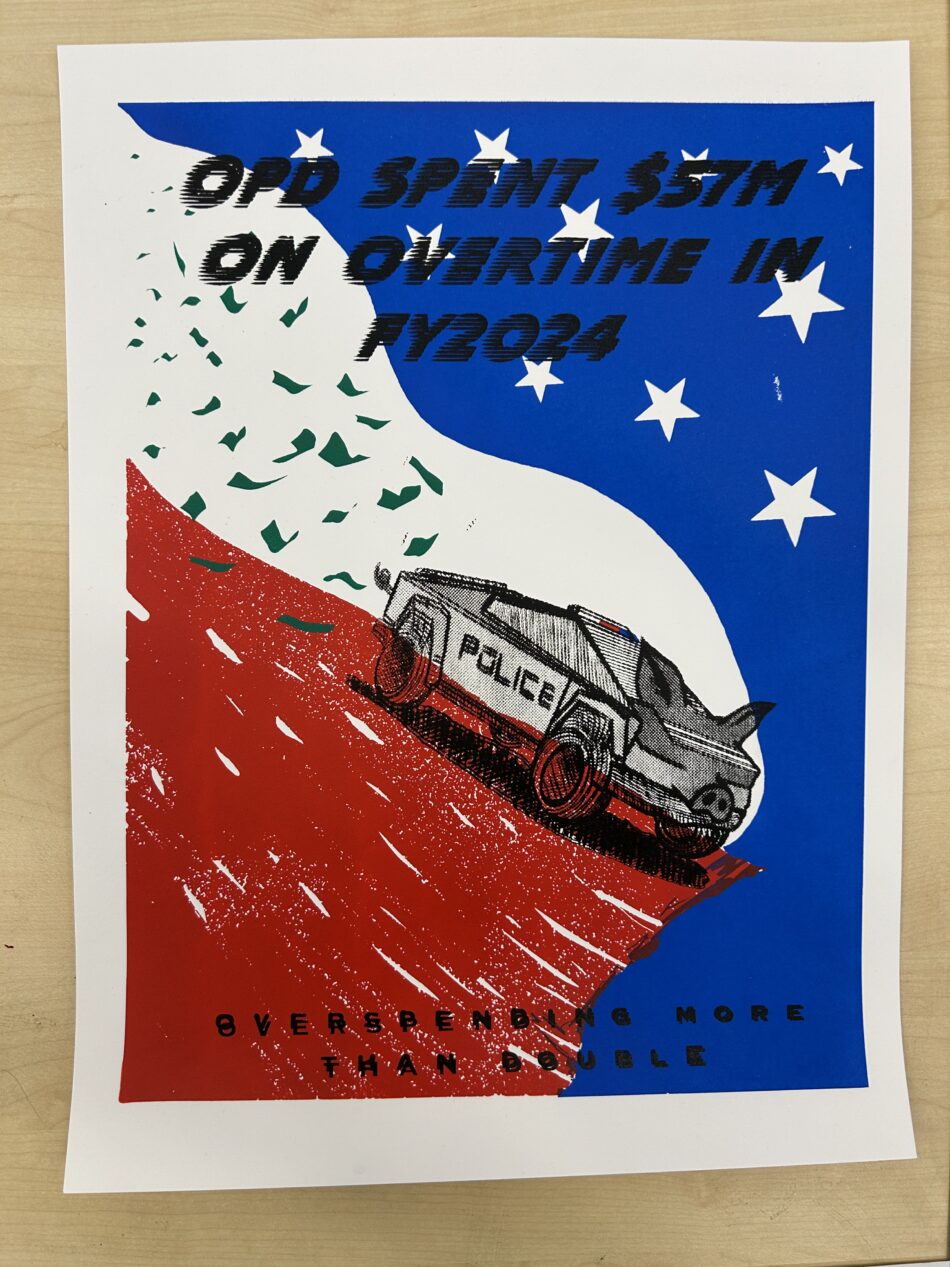
- Danbi Han reported on overtime spending by the Oakland Police Department, visualizing the issue through an illustration of a police Cybertruck careening downhill, trailed by dollar bills representing the amount of money spent on police overtime in FY2026, sourced from an article by The Oaklandside.
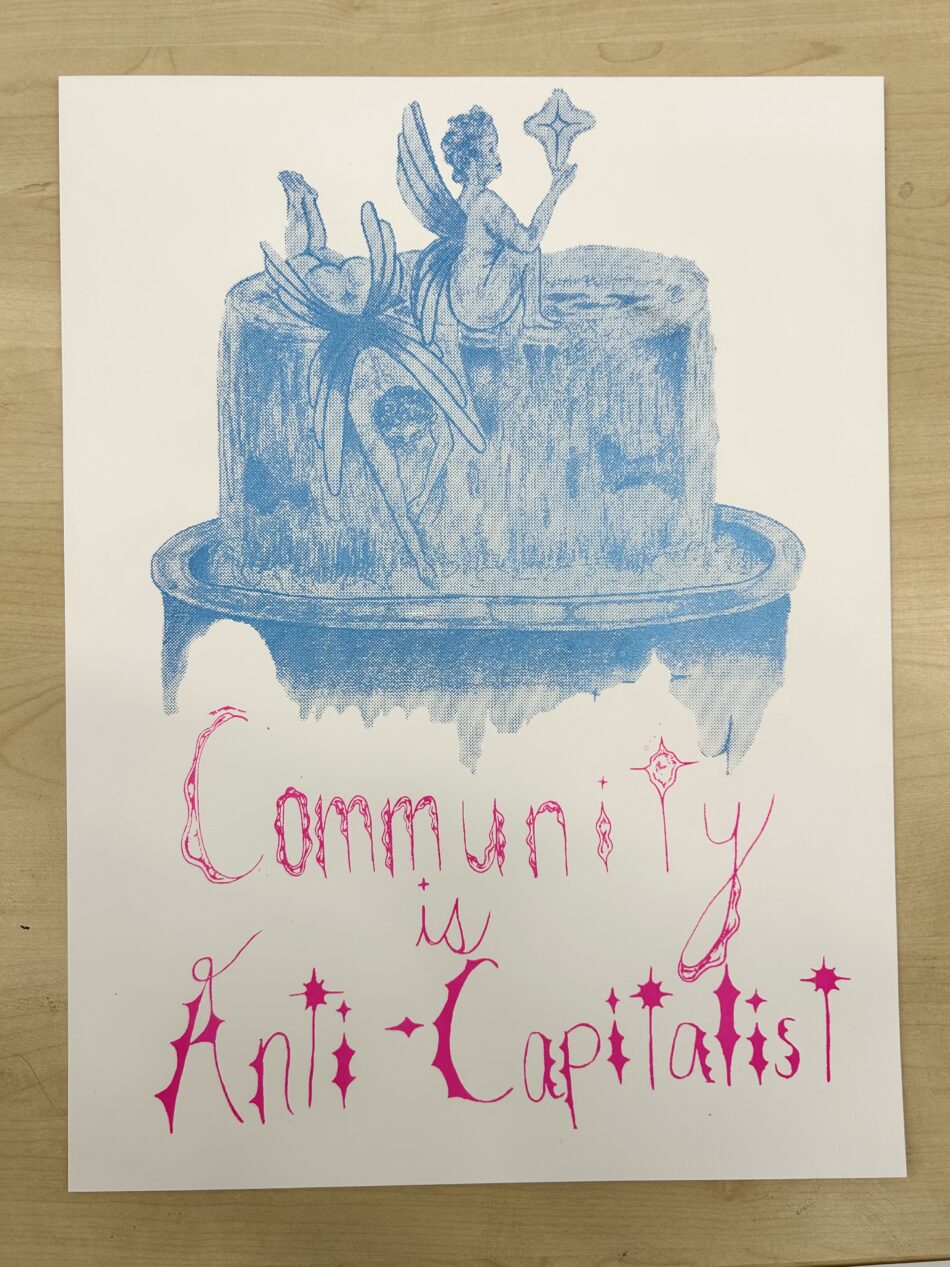
- Krystal Situ celebrated people who are struggling to create community and are finding third spaces to connect with one another. She was inspired by the Lincoln Square Recreation Center, a storied community space in Oakland’s Chinatown, and how it enables seniors like her own grandmother to uplift each other and practice joy.
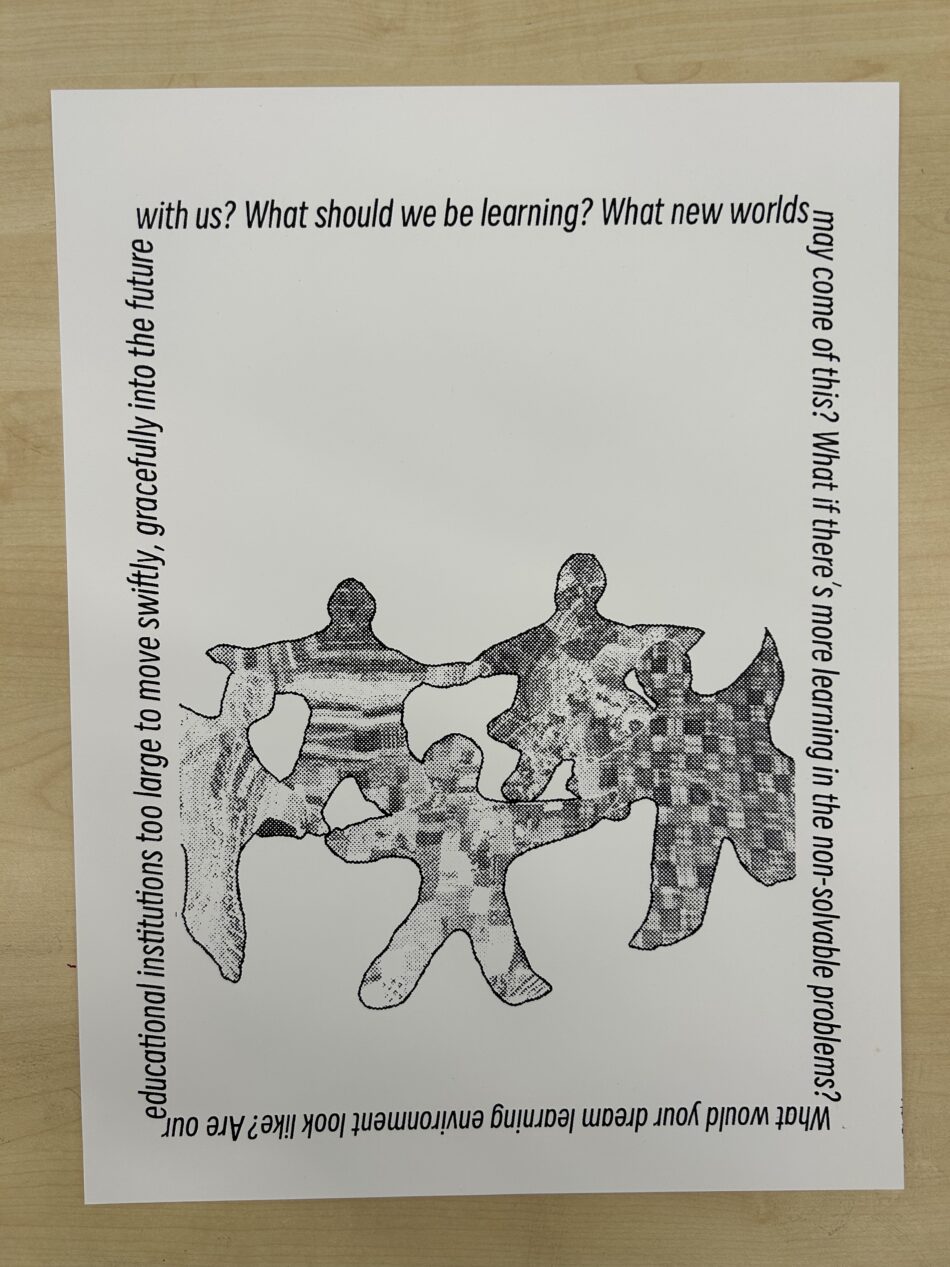
- Avery Huetter explored inequities in education through an “art interview,” inviting students to imagine their ideal learning environments. She printed a series of prompts on a large cloth and invited participants at a community event we hosted at the Lowdown to share their own ideas for public education.
What fellows learned, and what’s next
After the fellowship, Ancheta told J+D Lab that learning about the journalistic process deepened his ability to situate his art in a broader context and was a “stepping stone” to changing the way he approaches his art-making process.
“Journalism helps me piece together a puzzle,” said Ancheta. “In my art, I always go back to my personal experiences, but my personal experience is a very narrow detailed puzzle piece. Journalism helps me zoom out and look at the entire puzzle and see how my puzzle piece connects to another person’s and perhaps a different system.”
Ancheta said he’s having more conversations with friends about how to think critically, and even started a book exchange to spark more discussions with them about timely topics.
What Ancheta describes is exactly the type of outcome we’re hoping for with this fellowship: that more people will be able to learn journalism and apply it to their lives, creative practices, and communities in different ways to help people stay more informed and connected.
We’ll host the second cohort of our News/Print fellowship starting the week of September 28. If you know any community college students in the East Bay, encourage them to apply.