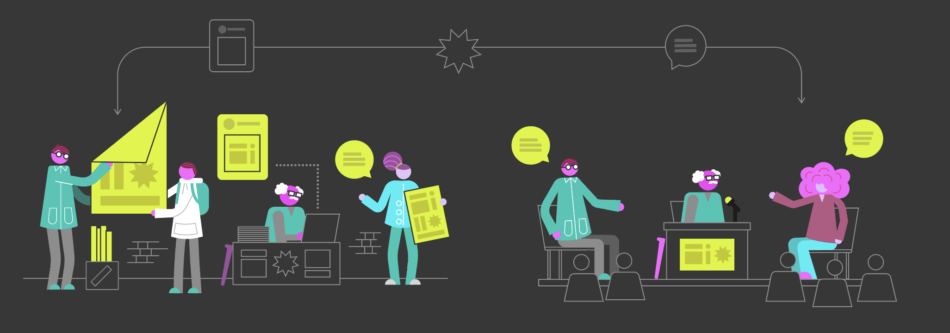
Across every community, people are doing the work of journalism, but often in informal ways through grassroots networks.
The Journalism + Design Lab is excited to share a new framework, Community News Roles, which broadens the definition of who contributes to local news ecosystems.
The framework consists of eight roles that any individual can undertake on their own, or in partnership with newsrooms and other community-based organizations, to keep their communities informed.
Here’s a synthesis of the community roles that J+D Lab outlines in the framework:
- Facilitating: Cultivating community listening, conversation, and connection.
- Documenting: Recording what’s happening in a community.
- Commenting: Sharing personal expertise or experience.
- Inquiring: Asking questions and digging deeper.
- Sensemaking: Helping others understand and contextualize issues and events.
- Amplifying: Curating, sharing and distributing news and information.
- Navigating: Assisting others in engaging with services and information they need.
- Enabling: Sharing time and resources to support local news.
J+D Lab believes it’s critical that anyone working to inform and connect their communities account for, and work in concert with, the everyday ways that people get and share information. With this framework, we ask: how might local newsrooms, community colleges, and other civic institutions better enable more people to responsibly and ethically perform these journalistic functions?
The full framework, including descriptions, visualizations and examples of each of the community news roles, can be viewed here.
The framework is the product of months of research, interviews, and is informed by the Journalism + Design Lab’s ongoing partnerships with community colleges, local newsrooms and other civic institutions. It’s part of a larger movement to reimagine what it means to do journalism, and who participates.
The Journalism + Design Lab is also inviting anyone to submit examples of what the community news roles look like in practice. The responses will be used in further iterations of the framework and published online.