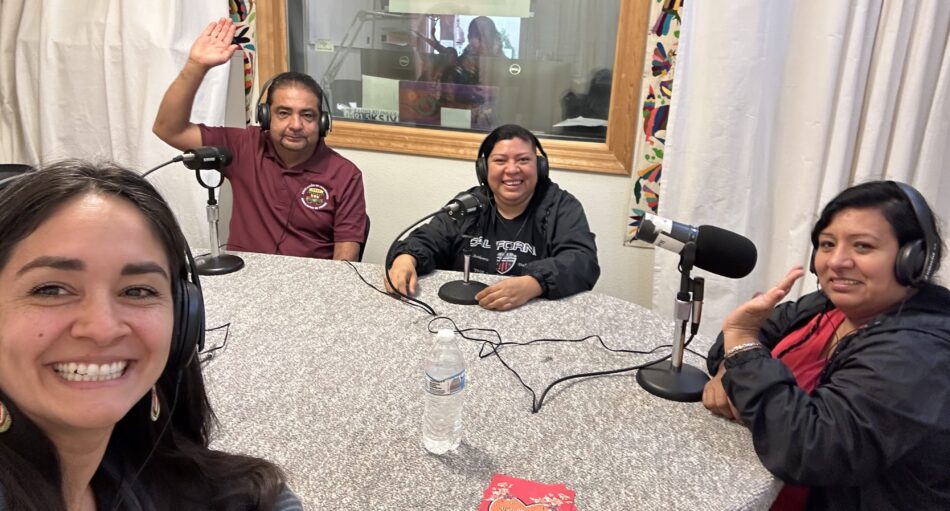
Ariana Martinez Lott wanted to become a more effective organizer for her communities in Fresno. A key part of that, she knew, was learning how to tell stories effectively and accurately. So she signed up for the Fresno Community Journalism Fellowship last summer, and joined a cohort of other residents as they learned tools to get and share information that their communities need to thrive.
“I always knew that storytelling was a big part of community organizing, but I had never had any formal training around it,” she said. “I wanted to learn how to tell stories that could connect with audiences that wouldn’t necessarily agree with me.”
The fellowship, a partnership between the Journalism + Design Lab, the nonprofit newsroom Fresnoland, and Fresno City College, was designed to invite residents into the journalistic process and help them connect local stories to larger systemic issues. For Martinez Lott, a seasoned community advocate and former city council employee, the experience upended her idea of what journalism was — and who could practice it.
“Part of my perception was that I wasn’t a true and active participant in the journalism process,” she said. “But it’s not just journalists who can tell a story. Community members can bring forward issues and help every day people connect with them.”
As part of the fellowship, Martinez Lott chose to report on the Fresno Unified School District, where two of her young children attended school. The district had recently received state funding for a community schools initiative, but Martinez Lott was frustrated about what she perceived as a disconnect between what the initiative said about parent engagement and a lack of effort to get parents involved.
Martinez Lott then experienced a truism of journalism: Not all ideas pan out. Digging revealed that the story she had been convinced of did not, in fact, hold water. “Once I pressed more into the topic, I didn’t feel like there was a story,” she said.
And while Martinez Lott left the fellowship without publishing a piece, the collapse of the story proved invaluable to her understanding of journalism, and her own career as a community activist.
“The program helped me make sense of the last 15 years of my experience,” she said. “It challenged me to ask, ‘are you doing your homework and getting the perspective of the other side?’ I think that’s something that as an advocate, I didn’t do enough of.”
It was that ability to analyze all aspects of an issue that became critical when, just a few months after concluding the fellowship, a group of Fresno street vendors contacted Martinez Lott for help. Several years prior, she had made contact with many of the vendors when she worked for a local city councilperson. Now, the vendors were facing new regulations from the Fresno city government that they said threatened their livelihoods.
“In California, the government decriminalized and legalized street vending and left it up to local jurisdictions to set up their own policies,” Martinez Lott explained. “It was intended to create pathways to accessibility. But unfortunately, what we’re seeing is that many cities are creating more barriers to vending.”
In Fresno, that looked like banning street vending in residential neighborhoods, prohibiting vendors from setting up shade in the scorching heat, and levying the maximum fines allowable under state law against vendors found with violations.
“The city’s original policy would have redlined street vendors in Fresno,” Martinez Lott said.
It was here that Martinez Lott says she applied the skills she learned in the fellowship to help the street vendors communicate their concerns pragmatically to the city council — and to use storytelling to advance their cause. She recalled how, after a few rounds of revisions on the bill, the sponsors came to her and the network of street vendors and announced that they would not be making any additional changes.
“In the past, I would have said, ‘this really stinks,’ and that would be it,” she said. “But this fellowship helped me understand that everyone has the ability to tell a story. We all have our own platforms. And we had to decide if we wanted to accept the policy, or take it to the public eye.”
It was at that point that Ariana and the vendors decided to start working with local media to tell their story and to launch an outreach campaign to all members of Fresno’s city council. Street vendors also spoke out publicly, at community meetings and events.
The final version of the policy was passed by the Fresno City Council in December, and included many changes resulting from the street vendors’ efforts. While Martinez Lott celebrates those changes as a victory, there’s been renewed efforts to further restrict street vending. On October 16, two city councilmembers introduced a measure to ban street vending from one of Fresno’s central entertainment districts on Friday and Saturday evenings, which Martinez Lott has vowed to fight.
“The most beautiful part was seeing the street vendors’ own development as leaders,” she said. “At the start of the process, there were two or three who were comfortable speaking in public. By the end, 30 or 40 of them had spoken out. Many of them had never set foot in city hall or a council meeting.”
Martinez Lott’s work with the street vendors may be remembered as the stepping stone to her political career. While she was advocating on their behalf, several individuals approached her about running for her local city council seat.
“I don’t think I would have considered it on my own, were it not for local leaders who encouraged me,” she said. “Ultimately it came down to: if you want to support equitable processes for the communities you want to work with, this is a more direct way to do it.”
In April, she announced her candidacy for city council in Fresno’s seventh district. The election for the seat is June 2, 2026.
Martinez Lott credits the fellowship with giving her the tools to tell more compelling stories in her advocacy and navigate the political dynamics of societal issues. Next year, she hopes to be on the other side of the negotiating table finding ways to involve constituents in policymaking.
“I’m a big believer in the power of what can happen when people know their neighbors,” she said. “I truly believe that creating spaces of belonging and getting to know one another can be a long-term onramp into getting engaged in systemic issues.”