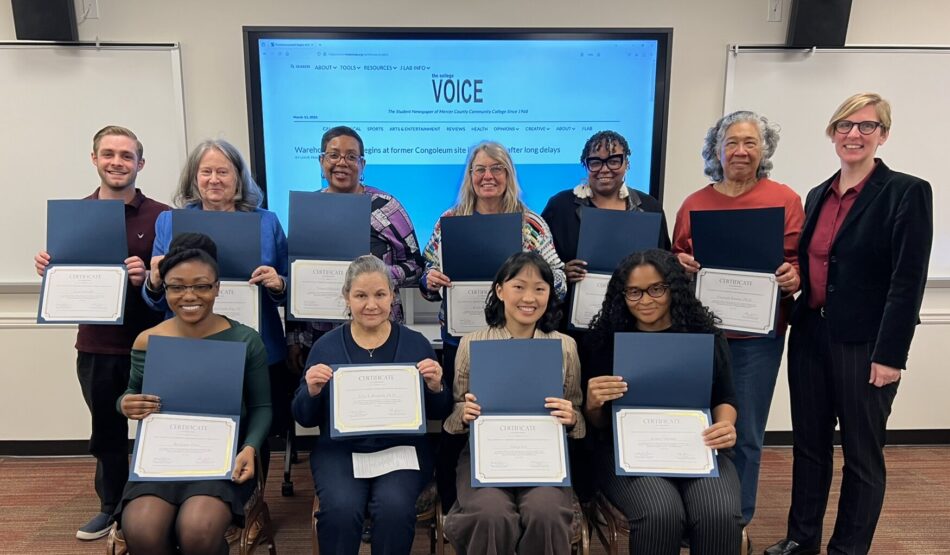
In January 2024, Mercer County Community College (MCCC) hosted its first Community Journalism Lab, or J Lab, a noncredit certificate program designed to train and support new community reporters from across Mercer County. Created and led by Holly Johnson, professor of communication and Journalism at MCCC, the program has since grown steadily over three cohorts, with participants publishing dozens of stories in The College VOICE and partnering with local media outlets including MercerMe, TAPinto, and Trenton Journal.
Backed by the New Jersey Council for the Humanities (NJCH) and the Journalism + Design Lab (J+D), the J Lab is one of four community journalism initiatives launched with a cohort of New Jersey community colleges, including: Sussex County Community College, Atlantic Cape Community College and Middlesex College. With funding from the New Jersey Civic Information Consortium, NJCH and J+D provided direct training and infrastructure support to each college’s project team, helping faculty create tailored programs rooted in their local news ecosystems.
With its fourth cohort launching in September 2025, we spoke with Johnson about what she has learned so far, how the program continues to evolve, and what advice she would offer to others hoping to build similar efforts in their own communities.
What have you learned from offering the J Lab courses that you couldn’t have predicted when you first started?
At the beginning, I tried not to get my hopes up. I told colleagues that if even three people showed up, that would be a win. But even as I said that, I found myself imagining a full room of students, each writing a complete, publishable article by the end. In a burst of optimism, I planned a guest speakers’ night, knowing I might be the only one there.
As the start date approached, I checked the registration page daily to see if anyone had signed up. When the first name appeared, I was ecstatic. When it reached five, I started holding my breath. How high could we go? Eleven. Sixteen. We hit the class cap of 20 just two days before the program began. That is when the anxiety kicked in.
I have been teaching journalism for twenty years, but the J Lab was something new. I could not find a model for it, and I had never taught in continuing ed. I condensed the core of my “Journalism I” course and focused more heavily on community reporting.
And then the first night arrived, and in they came: mothers, grandmothers, immigrants, high school seniors, veterans, nurses. They were exactly the colorful, interesting bunch I had barely let myself hope for.
What I learned from that wonderful, patient first cohort was how much they would build community with one another, how they would help each other build confidence. I saw how deeply people value the chance to tell their own stories and how hungry they are to learn the tools to do it well.
How have you evolved the course across the three different J Lab cohorts you’ve taught?
Over the first three cohorts, we have identified what works well and made changes in response to needs we did not initially anticipate. Based on student feedback, we extended the course from six to eight weeks and lengthened each session from two to two and a half hours. That extra time has allowed participants to settle in, connect with one another, and work without feeling rushed.
We also ran into technology challenges. Many students were unfamiliar with document-sharing platforms, online feedback tools, or basic search techniques for fact-checking. Some needed help uploading photos. To support them without sacrificing core instruction time, I brought on a teaching assistant who could run pull-out groups focused on digital skills.
Transportation quickly emerged as another barrier. Our public transit system is limited, and as the class meets in the evening, many students are not comfortable driving after dark. During our first cohort, we organized an informal carpool. Since then, we have added a ride-share gift card program to help students from across the county participate.
Finally, we have continued to refine the curriculum itself. We have added new sections on solutions journalism, data mining, and how to navigate conflicts of interest — topics that are especially relevant for community reporters.
What are some of your favorite examples of how the program has had an impact so far?
I love that the stories students choose to tell are ones no one else would think to write, stories that would otherwise go overlooked, but that they know because they are embedded in their own communities. They have written about thrift shops, over-55 housing challenges, death doulas, dog parks, even a pork roll eating contest.
Early on, we linked the J Lab to The College VOICE, our campus newspaper, to give participants a platform for publication. Our degree-seeking student editors help edit the J Lab participants’ final projects. At the certificate ceremony, each graduate presents their piece to the community. Seeing their stories published online and being able to share them with friends and family is a meaningful payoff.
We have also built partnerships with grassroots media outlets, and many J Lab graduates now freelance for local publications. The relationships they have built and the way their work has extended into the wider community is my favorite part of the program.
What advice would you give someone who wants to start a similar noncredit community journalism program?
Institutions vary so much that what we did might not be replicable elsewhere. But if our program can serve as a starting point, here are some ideas that might be useful:
- Connect what you are building with what you already have. We tied the J Lab to our student newspaper, The College VOICE, and published a special section of J Lab articles. Our student editors helped edit participant stories, and some J Lab students later attended VOICE meetings. The relationship has benefited both groups.
- Have a plan, but be willing to revise it. A healthy combination of organization and flexibility is essential. If we had gotten too locked into one plan, the program would not have been effective. If we hadn’t had a plan, we would not have gotten it off the ground.
- Look for creative ways to stretch your funds. Sometimes the most valuable support comes from outside the budget lines. For example, we built partnerships across academic departments and with community organizations that opened up new opportunities and visibility.
- Play to your strengths. Whatever your background — editing, field reporting, teaching, organizing — lean into that. The program will take on the shape of your strengths.
- Learn how to teach. A lot of people know how to do something but don’t know how to teach others to do it. Building a good community journalism program where students can generate ethical, well-researched, engaging stories means breaking reporting skills down for them and teaching them piece by piece. Reach out to a full-time journalism educator to help you build your curriculum and teaching tools if you don’t yet have that skillset.
- Try not to worry about failure. The fact that we didn’t have many models to draw from was disorienting at first, but it also felt like we could try anything and not worry about “failure.” That was liberating.
What’s next for the J Lab?
We are preparing to launch our fourth J Lab cohort on Thursday, September 4, 2025 (registration is open). We are also continuing our support for graduates, particularly those now freelancing for local media outlets. Our partnerships with grassroots publications have grown steadily, and we remain committed to providing ongoing mentorship, editorial feedback, and connection opportunities for community reporters who got their start through the J Lab.
Looking ahead, we hope to launch J Lab Odyssey, a version of the program designed for high school students. It would run in alternating semesters with the original J Lab and focus on core community reporting skills, as well as media literacy, misinformation, and fact-checking.
We have also received frequent requests from graduates to offer a follow-up program. While a full “J Lab II” is not feasible, we have a long-term vision for a J Lab Workshop Series open to program graduates and other community reporters. Each session would begin with instruction focused on a particular skill, led by the J Lab instructor or a guest professional. The second half would be open lab time for participants to work on their writing and receive feedback on any aspect of their work. The goal would be to offer continuing education and create space for community reporters to connect, share stories, and build a lasting network of support.
Of course, sustaining our work requires continued funding. Our current grant support is projected to carry us through spring 2026. To extend the program beyond that point, we are actively exploring new funding sources and partnerships. The momentum is there, and we are committed to finding ways to keep the J Lab thriving.