What would it look like if more newsrooms built on the abundance, diversity and momentum already in their communities to strengthen local news?
In a new article for The Objective, I outline the opportunity for newsrooms to take a more collaborative, networked approach to meeting local information needs. The piece shares examples of how newsrooms have enabled more people to participate in sharing reliable information, strengthening their ability to serve local communities and growing more resilient news systems in the process.
The piece builds on the framework of “Community News Roles” that our team recently published at the Journalism + Design Lab, which breaks down core journalistic functions into a set of different actions that community members can – and do – perform to produce, share, and act on reliable information. These roles include facilitating, documenting, commenting, inquiring, sensemaking, amplifying, navigating and enabling.
For example: the volunteer who documents ICE raids to notify vulnerable community members, the librarian who helps people navigate resources for affordable housing, and the social media creators who help people make sense of issues impacting their communities.
Naming these roles is the first step in expanding the idea of who contributes to local news. By mapping the different ways that people help keep their communities informed, newsrooms can build opportunities that invite and inspire more people to play an active part in circulating reliable information.
When newsrooms embrace their unique contributions to local news and information while also working in concert with community members playing distinct, complementary roles, they can build more resilient news ecosystems that more readily serve local communities.
Moving from newsroom to network
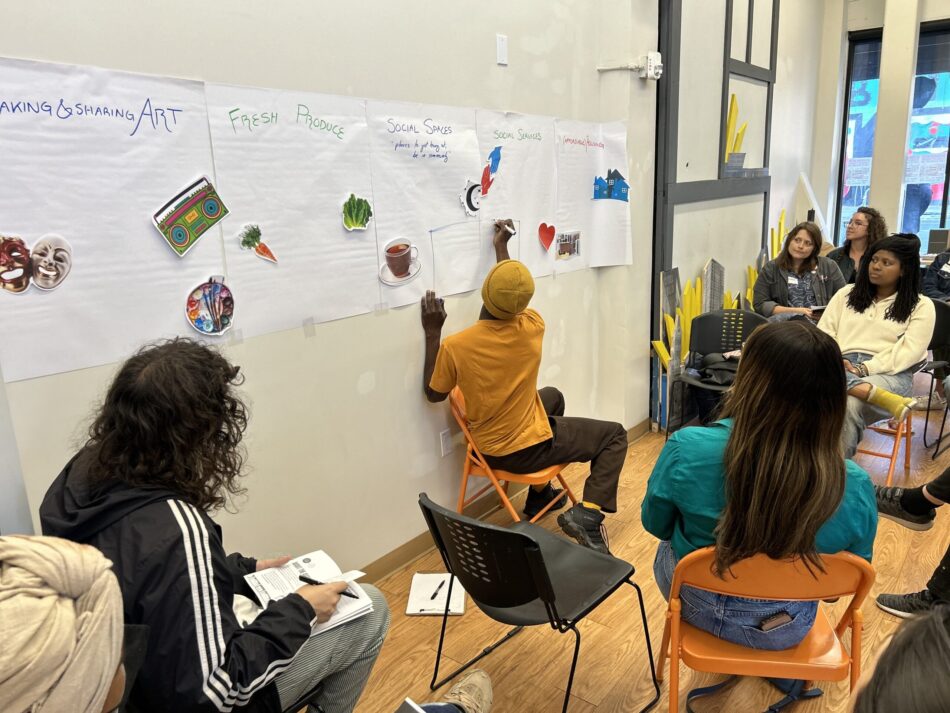
We know that there is a strong appetite in this approach among people working in local news. Last month, J+D Lab partnered with the Online News Association and facilitated an online workshop to share the framework with folks in the media industry and share ideas for how newsrooms could better enable community news roles.
More than 300 people registered for the event and nearly 100 people participated, making it clear that there’s excitement and urgency in exploring different ways to tap the abundance in our local communities. You can watch the recording of the session here.
“I’ve always felt this tension between doing journalism and identifying as a journalist,” said Ariam Alula, Director of Communications + Engagement at We CU, in the chat during the workshop. “One of the things I think this framework gets right is that it gives community members the language to describe what they’re doing — it emphasizes the doing — without making it their identity.”
Putting the framework into practice: Where to start
So how can local journalists and civic media practitioners build programs and pathways that better enable these community news roles? Our team at J+D Lab launched a companion resource at our workshop with ONA that’s designed to help you get started.
The worksheet provides some guided reflection and mapping to help journalists understand how people are already contributing to the flow of news and information, and identify opportunities and approaches that tap into these existing networks. It’s not a comprehensive mapping tool, but can be used as a resource to break the ice and leverage the Community New Roles framework as a conversation starter in your organization.
The framework in action
We’ve already heard from so many practitioners who are building on the Community News Roles framework in a variety of ways, sharing new ideas for how newsrooms could incorporate more of a focus on collaborating with their communities:
- Before the framework was even published, our colleagues at Commoner Company incorporated it as a key pillar in their report for Press Forward to outline how we can better understand and support the news and information sources serving today’s communities.
- Patrick Boehler of Gazetta has incorporated the framework into a series of writings on journalism and systemic disruption, including this excellent post that draws from the framework to posit a “civic opportunity matrix.”
- Led by Jennifer Brandel and Jihii Jolly, the recently published News Futures Civic Media Cookbook, “Recipes to Produce Civic Media Through Participation, Power and Community,” spotlights the framework.
- Fabienne Meijer, head of journalism products at the Organized Crime and Corruption Reporting Project, wrote in Dutch about Community News Roles, combining our framework with others to convey new opportunities for how journalists can serve communities and more clearly demonstrate their value.
- Yoni Greenbaum, VP of product strategy at American Press Institute (API), cited the framework in a recent call for newsrooms to use “pod mapping” as a tool for building trust and deeper relationships across a community.
- API also used the framework as a core activity and contextual piece as part of their Local News Summit on “Inclusion, Belonging and Local Leadership,” held last October in D.C.
- For Northwestern University’s Local News Initiative, Eric Rynston-Lobel highlighted our work and what newsrooms can learn from informal news networks.
What’s next? Help us grow this framework
We’re eager to hear from others who are interested in applying or adapting this framework. Here are a few specific ways you can help us build on it:
- Share your feedback and examples. J+D Lab is looking for specific examples of people you know who are playing these roles in your community, and would love your feedback on the framework itself. Share your feedback, ideas and examples here.
- Help support this work. Journalism + Design Lab is interested in funding and partnership opportunities to build on this framework and develop curriculum, programming and community resources. If you’re interested in supporting or partnering on this work, please get in touch with Cole Goins, Managing Director of Journalism + Design Lab: goinsm@newschool.edu
- Want updates? Sign up to get Journalism + Design Lab’s newsletter for information on programs, tools and resources, related to the framework.