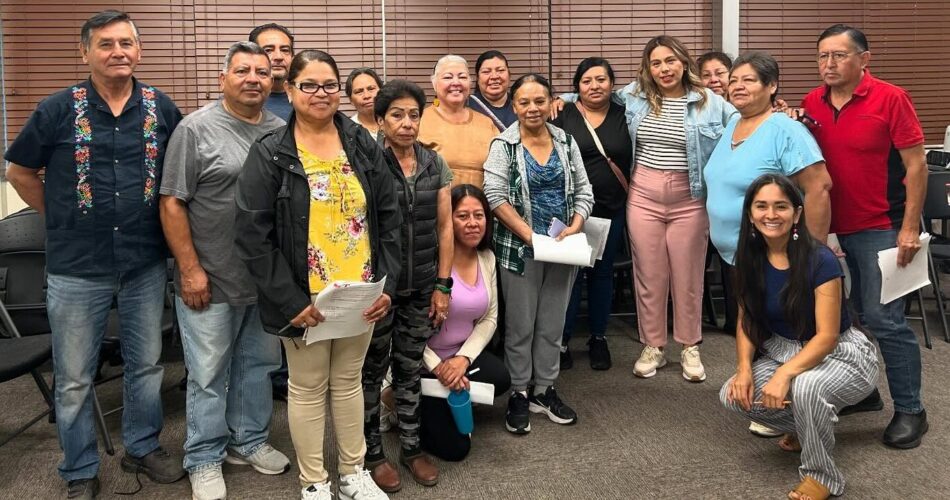
When Ariana Martinez Lott was selected for the Fresno Community Journalism Fellowship last summer, she was a former city employee eager to get involved in the “business of neighboring.”
“I’m in the place of just really valuing the power of getting to know neighbors,” said Martinez Lott. “Like, what kind of impact can happen when my neighbors just know more neighbors?”
She joined the fellowship hoping to learn journalistic principles and storytelling tools that could help her advocate for her community, like a network of local street vendors she had built relationships with during her time at City Hall. She didn’t know that she, and the others in the inaugural fellowship cohort, would apply those tools in many different ways: as community leaders, connectors, and story-sharers.
Launched last summer in partnership between the Journalism + Design lab (J+D), nonprofit newsroom Fresnoland, and Fresno City College (FCC), the Fresno Community Journalism Fellowship is a paid opportunity to equip community members with journalism skills as a means of getting more civically engaged and contributing to the flow of reliable news and information.
The fellowship’s inaugural class included ten participants from neighborhoods throughout the city, and from all walks of life: from seasoned community organizers to youth media producers to a recent high school graduate.
Led by FCC instructors Paul Swearengin and Kathleen Schock, the fellowship was an opportunity to extend the college’s journalism program beyond the classroom and into the community.
The workshops included instruction from Swearengin, Schock, and staff from Fresnoland and the Journalism + Design lab. Fellows learned the fundamentals of journalism, how to produce compelling stories and how to understand and engage with the systems at play in the issues they care about.
“It was incredibly rewarding to witness the fellows not only refine their journalistic skills but also develop a deeper understanding of how their reporting can contribute to civic engagement,” said Schock. “Seeing them grow as storytellers and critical thinkers, while making meaningful connections with the people and issues shaping their communities, was a powerful and affirming experience.”
Through a collaboration with CMAC, the Community Media Access Collaborative, the fellows and program facilitators produced a video uplifting the important topics and learnings surfaced throughout the program.
Spotlighting underreported issues in Fresno’s communities
Each fellow chose a topic they were passionate about that they would report on over the course of the program. They were encouraged to draw from issues that they saw affecting people in their neighborhoods and in their local networks.
For instance, Crystal Peralta researched how truck routes were affecting air quality in her neighborhood; Grace Nishanian explored the effects of teen drug abuse; Mateo Fernandez looked at accessibility for people with mental disabilities at FCC; and Dr. Kamille Williams reported on the importance of Black doulas in Fresno.
Other fellows applied their learnings to community projects after the fellowship was over. Martinez Lott got involved with a new policy put forth by Fresno’s city council that would regulate street vending. When the policy was made known to the community in September, she helped connect street vendors with city council members to share their firsthand experience, and explain how the new rules would impact them directly.
In response to the vendors’ organizing, the council ended up delaying the policy’s first of two votes to make changes that addressed some of the vendors’ concerns. While vendors were still disappointed with the final ordinance, Martinez Lott says they were proud of their ability to organize in such a short time, and feel more empowered in sharing their stories.
“Ultimately, this is a story about who has perceived political power to decide who belongs and who doesn’t, so we had to push back against that narrative,” said Martinez Lott. “I gained a lot of experience from the fellowship program in terms of: what does it mean for us to help a larger community connect to how this issue is impacting a part of our community?”
Josiah Poynter, editor of FCC’s student newspaper, The Rampage, reported on Fresno’s unhoused community. His mother worked on issues surrounding homelessness when she first graduated college, and Poynter says it’s something that’s always been important to him. He worked with The Rampage staff to dedicate the paper’s December 2024 issue to a variety of stories exploring homelessness and housing insecurity at FCC and the greater Fresno community.
“Without the fellowship, I wouldn’t have been able to know how to write about homelessness and how to go about it from an editorial perspective. And [the Rampage’s issue] was really popular and it made a lot of difference, I think, to the people I talked to about it,” Poynter said.
Enabling more participatory news networks
The core goal of the fellowship program was to equip more people with the tools to tell stories from within communities. But beyond news articles and more traditional journalistic outputs, the fellows learned skills to help them connect with, and serve, their community in new ways.
Some fellows told us they became more active readers of local news, including Fresnoland. They said they learned how to ask better questions, how to listen more deeply and how to connect stories they see to larger systems at play. For several fellows, the workshops enabled them to be better leaders.
“For me, at the end, the tools I was learning were playing out in real life,” said Martinez Lott. “I hope to apply these lessons in how I engage as a community leader.”
Fellows also shared their ideas on how journalism could better serve and represent people.
Dr. Williams, who leads a nonprofit that mentors foster and underserved youth, emphasized the importance of having more community journalists as “boots on the ground” who can go deeper into neighborhoods that only get surface-level coverage.
“We’re giving voice to the people that typically wouldn’t be on the news or typically wouldn’t have a camera in their face or wouldn’t be able to articulate what they want to say in a 30 second clip,” said Williams. “Journalism gives them that elongated space and that voice to do so.”
Fernandez, a student at College of the Sequoias, sees the potential for journalism to help mobilize people so they understand what’s going on around them and know enough to be able to act. “When you can connect it back to people, you can help them help each other,” Fernandez said.
For Poynter, the changing formats of journalism provides hope for the future.
“Journalism always, at its core, is about accountability and transparency … that’s always going to stay the same,” said Poynter. “But how you tell those kinds of stories is always changing … I think journalism is becoming more human.”
The 2024 Fresno Community Journalism Fellows:
Carolyn Bailey, Mateo Fernandez, Jillian Leslie, Ariana Martinez Lott, Ashens Limon, Grace Nishanian, Crystal Peralta, Josiah Poynter, Dr. Kamille Williams, Pepe Zamora
Fellowship Facilitator: Paul Swearengin, FCC
Instructors: Kathleen Schock, FCC; Paul Swearengin, FCC; Danielle Bergstrom, Fresnoland; Megan Lucero and Cole Goins, Journalism + Design lab